Kubernetes List Environment Variables
Define an environment variable for a container. Those environment variables match the syntax of Docker links.
Kubernetes Environment Variables Explanation And Examples
You can also mount the values as files inside the Pod.
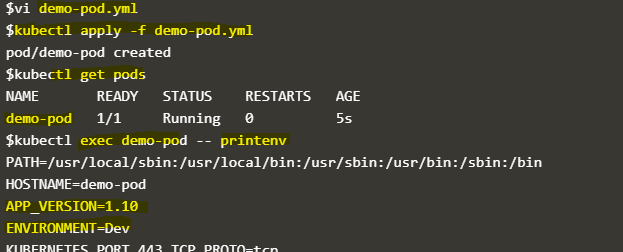
Kubernetes list environment variables. In your shell run the printenv command to list the environment variables. In this exercise you create a Pod that runs one container. Kubernetes ConfigMap decouples the application data from the application.
You write the code to look in an environment variable named DATABASE_HOST. Define an environment dependent variable for a container. In the configuration file you can see five environment variables.
As container environment variable. Setting and Unsetting Environment Variables OpenShift Container Platform provides the oc set env command to set or unset environment variables for objects that have a pod template such as replication controllers or deployment configurations. The name of a Secret object must be a valid DNS subdomain name.
Kubectl run nginx --imagenginx --restartAlways --replicas1 --envvar1val1 The above command will create a deployment nginx with replica 1 and environment variable var1val1. Download a volume and set the path to that volume as an environment variable. Kubectl exec -it envar-demo -- binbash.
Kubectl exec -it -- printenv grep -i env. Edited Mar 23 at 1604. Make a service running on your cluster available to processes running on your development computer.
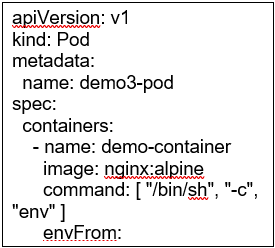
To set environment variables include the env or envFrom field in the configuration file. Kubernetes will look for each key in the ConfigMap and set its value as an environment variable in the container. In the cloud you set it to refer to a Kubernetes Service that exposes the database component to your cluster.
You can use following command. For a service named foo that maps to a container port named bar the following variables are defined. Now when your Spring Boot application starts it will be given those environment variables which will override your applicationproperties.
Play with Kubernetes. When you create a Pod you can set environment variables for the containers that run in the Pod. Get a shell to the container running in your Pod.
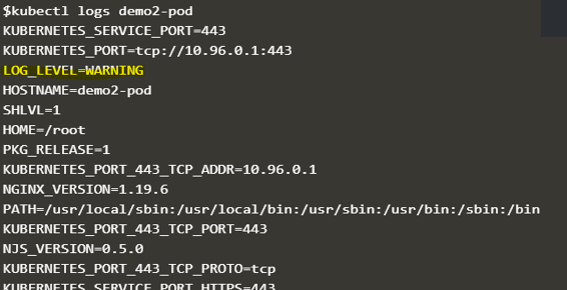
The output is similar to this. A list of all services that were running when a Container was created are available to that Container as environment variables. You can specify the data andor the stringData field when creating a configuration file for a Secret.
The other way to export the environment variable is use kubectl run not advisable as it is going to be depreciated very soon. This lets you fetch a container image running in the cloud and debug the exact same code locally if needed. When you create a Pod you can set dependent environment variables for the containers that run in the Pod.
Locally you set that variable to localhost. Alternatively you can also use kubectl exec to display the environment variables within the container. By the kubelet when pulling images for the Pod.
Create an environment variable with a constant value. Answered Feb 19 at 726. In this exercise you create a Pod that runs one container.
You can specify the following actions in a KubernetesLocalProcessConfigyaml file. It is used to set and define environment variables inside the Pod container. NODE_VERSION442 EXAMPLE_SERVICE_PORT_8080_TCP_ADDR103245237 HOSTNAMEenvar-demo.
You will get all environment variables that consists env keyword. The first element in the array specifies that the MY_NODE_NAME environment variable gets its value from the Pods specnodeName field. Kubernetes secrets exposed by environment variables may be able to be enumerated on the host via proc.
PATH usrlocalbinusrlocalsbinusrlocalbinusrsbinusrbinsbinbin HOSTNAME envs SIMPLE_SERVICE_VERSION 10 KUBERNETES_PORT_53_UDP_ADDR 1723001 KUBERNETES_PORT_53_TCP_PORT 53 ROUTER_PORT_443_TCP_PROTO tcp. To set dependent environment variables you can use VAR_NAME in the value of env in the configuration file. If this is the case its probably safer to load them via volume mounts.
It can also list environment variables in pods or any object that has a pod template. The env field is an array of EnvVars.
Kubernetes Environment Variables Explanation And Examples
Kubernetes Environment Variables Explanation And Examples
Kubernetes Environment Variables Explanation And Examples

Kubernetes Configmaps Usage To Declare Env Variables Golinuxcloud
